Showing posts with label Agnes Martin. Show all posts
Showing posts with label Agnes Martin. Show all posts
Sunday, January 30, 2011



Tuesday, January 11, 2011
What We Do Not See If We Do Not See
by Agnes Martin
We all believe in life.
We feel a certain devotion.
We feel called upon to live as good a life as we can.
We feel that we are in the dark and that even in darkness we
must struggle to know what is best to do.
Not altogether but each one every moment.
We feel that we should not live in just the same way as our
ancestors lived. We feel that we should take a step forward.
We know that this step will be in the dark and will require
courage.
Our tremendous urge forward has a grip of steel.
Because we are in the dark there is suffering and difficulty.
Life is an adventure and adventures are difficult
They are hard work and one does not know how they will go on
or how they will end.
Nevertheless we have a tremendous appetite for the adventure
of life.
We are continually restless if we are not moving forward
according to our potential.
Although we are in the dark we are not without guidance.
Our guidance is called inspiration.
In crisis we say to ourselves: "What can I do", and miraculously
our mind answers and tells us what to do.
The miraculous answer is called an idea very often but it is not
an idea.
There are different parts of the mind.
When we are angry one part of the mind stands as though
outside and we see ourselves raving.
This part that stands as the outside of ourselves is the conscious
mind.
The conscious mind that is aware of perfection, happiness and
the sublime.
When we see ourselves with the conscious mind angry and
perhaps raving we fell guilty.
We recognize that we are off the path - We are off the path of
true life.
The conscious mind says Yes and No.
When it says: "Yes, go ahead, this is the way", we feel happy.
When it says: "You should not be here and you should not be doing this". At those times we feel unhappy.
Our problem is not that we do not see or hear the conscious
mind but that we do not obey.
When we see ourselves angry and the conscious mind is saying
"No" we still go on.
And when it says" "You should not go" we rationalize and say:
"Everyone else is going".
We knowingly disobey the conscious mind.
In this life we are struggling from death into life.
This has been remarked by all sages of all times.
The adventure of life is the relinquishing of death and the
acceptance of life.
In the lives that we lead there is both life and death.
The conscious mind is life and happiness and all things sublime.
Death is all things anti-life and truth.
The most dangerous anti-life and destructive tendency is self
deception known as fantasy. Imagining that we are other than we are.
The opposite of fantasy, true knowledge of self, is the greatest
wisdom.
The conscious mind is awareness of the sublime and it tells us
what to do by showing us when we are off the track.
Obedience to the conscious mind carries us forward to greater
awareness.
Disobedience of the consiciou mind carries us backward to less
awareness.
With more accurate obedience we become rapidly more aware
of the sublime: of beauty and happiness in life.
We become more devoted to life.
With disobdience we become less and less aware with less
respect for life.
This is the side of death in the adventure of life versus death. We
will be disrespectful of life and everything in it, even of our-
selves. We will be complaining and destructive and we will have
resistance to living our own life.
Other peoples lives will look better to us than our own life, more
interesting and more rewarding.
This is a very unnatural state of mind. If you have this state of
mind you must recognize at once that you are very far off the
track of life and happiness.
To correct this state of mind you must say to yourself: "I want
to live a true life."
That is all you have to do to turn from death to life.
Asking for life and truth you will be on the side of life and
against death.
I will not speak any more of death because it does not count.
Reality is positive.
Art work is a celebration of reality of the positive.
A positive response to life (which we call happiness) is not a
single response. It is infinitely various and goes far beyond what
we are able to bear.
We cannot reproduce reality or represent it correctly. It is
ineffable.
In art work we represent our own happiness because of our
awareness of the infinite sublimity of reality.
Without awareness of beauty, innocence and happiness and
without happiness oneself one cannot make works of art.
Criticism and discontent expressed concretely are complaint and
destructiveness. All negative expression is anti-life and anti-art.
Besides recognition of the sublime there are two other elements
in life that must be recognized and lived.
They are self knowledge and potential.
If you have enough respect for yourself you will ask yourself:
"What am I."
If the answer is "I am a man" then the question becomes: "What
is a man."
When you come to the end of all ideas you will still have no
definitive knowledge on the subject. Then you will have to wait
for inspiration.
Until you can clear up your true identity you will be tied to a
repetition of this life.
I have come to tell you the easiest way to find an answer to this
question.
First you must say to yourself "I want to live a true life." Then
you must watch your mind to see the response that it is making
to life.
You will discover the true response that you yourself make to
life undistorted by the ideas of others.
You will make discoveries every day and they will all be very
helpful.
Just as consciousness of the sublime is the path of life so is self
knowledge the path of life.
Neither consciousness nor self knowledge can be pursued so-
cially.
In groups we can compare our observations of life but life itself
is lived by individuals.
Changes in social living are the result of changes that take place
in individuals.
First some truth must be recognized by and idividual (that is
what we call inspiration) and then it must be expressed con-
cretely and responded to by others.
The cause of these changes is not with us but is a result of the
battle of life and death.
It is not just big inspirations that move life forward.
Every time an individual asks his mind what to do and receives
direction and acts upon it life moves forward.
Since we almost all live in this way life moves forward very
rapidly even though we have some tremendous setbacks.
It is up to us only in that our pursuit of awareness is on the side
of life.
As life is recognized death is over come.
The only triumph in life is the triumph of life itself.
Our awareness of it we feel as happiness.
Art work represents this happiness.
It does not represent life because life is infinite, dimensionless. It
is consciousness of itself. And that cannot be represented.
But our positive response to life can be, has been, and is
represented in art work.
And now we come to the last element to be considered, our
individual potential.
We, each of us feels that our life is not like anyone else's life and
that is absolutely true, infinitely true.
To live an absolutely original life one has only to be oneself.
In nature there is no sameness anywhere. There are no two rocks
alike, no days alike, no moments alike even forever.
And no two people alike or any moment of their lives.
It follows from this that we cannot help one another since our responses are not alike.
Since we are not alike in the experience of others is of no use to us.
This is particularly obvious when we wish to know what to do.
We are all born with a certain potential. It is different from that
of anyone else and it is necessary to life.
We must unfold our potential as a contrubution to life.
We are born to do certain things and we are born to fill a certain
need.
If there is a bare spot on the ground the best possible weed for
that environment will grow.
In the same way our lives are created out of necessity and we are
created with the potential to meet the necessity.
The resistance to function, that is our resistance to the unfolding
of our potential is due to the strength of the negative in life.
We are born as verbs rather than nouns.
We are born to function in life, to work and do all positive
actions that will carry out our potential.
When our potential is fully expended we will not be back. Our
concrete existence will come to an end.
Our ideas - deductions made from observed facts of life, are of
no use in the unfolding of potential.
Only obedience to the conscious mind counts. That is lke saying
only inspiration counts.
Inspiration is a command. While you have a choice that is not
inspiration.
If a decision is required that is not inspiration and you should
not do anything by decision. It is simply a waste of time.
Things done by decision even if it is a summit decision are in-
effective and they will be undone.
Only actions carried out in obedience to inspiration are effective.
When we first begin art work we usually have a lot of ideas that
we have to try. But nothing that we do really satisfies us.
Finally we are absolutely defeated. We do not know what to do.
I want to try to explain to you that defeat is the beginning, not
the end of all positive action.
A baby learning to walk knows that if he stands on his feet he
will fall. He knows that he cannot walk. He is defeated and
helpless.
This knowledge is an absolute prerequisite to inspiration.
Defeated and helpless he receives the inspiration to get to his
feet.
He is not defeated and helpless with regard to taking a step but
again he is commanded forward.
At every moment we are helpless and defeated and at every
moment we are commanded forward by inspiration.
There is no choice while we are on the true path.
Our inspirations come as a surprise to us.
Following them our lives are fresh and unpredictable.
But if in disobedience we imitate the lives of others or follow
concepts or perecepts our lives will be dull and unsatisfying and
predictable.
The unfolding of potential in obedience to inspiration is happi-
ness in this life. An ardous happiness in which we move
forward.
Disobedience is unhappiness and moving toward unconsciousness.
Happiness is self sought. It is life
You can only bring happiness to others by being happy yourself.
You can only be happy by being on the path of your unfolding
potential.
The path will be revealed to you by a request to your own
mind.
If your mind is concerned with the political, with policies and
methods, with causes and reforms your work will not be in the
art field.
The Greeks made a great discovery. They discovered that in
Nature there are no perfect circles or straight lines or equal
spaces.
Yet they discovered that their interest and inclination was in the
perfection of circles and lines, and that in their minds they could
see them and that they were then able to make them.
They realized that the mind knows what the eye has not seen but
that what the mind knows is perfection.
They determined that with the help of the conscious mind to
attain to perfection.
Because the Greeks sought the guidance of their conscious mind
their work is very inspiring to us. Because they were inspired we
are inspired by their work.
Work that is guided by the conscious mind is immediately
responded to by others.
It is very easy to see how Greek art has been a very for-life-
against-death action.
Today we realize that perfection is out of reach for us because
we ourselves are a part of nature but it is still our greatest interest.
What we see now is that the path pointed out to us by the
Greeks, the path guided by the conscious mind, is the path of life
and happiness and accomplishment in this world.
To discover the conscious mind in a world where intellect is held
to be valuable requires solitude - quite a lot of solitude.
We have been very strenuously conditioned against solitude. To
be alone is considered to be a grievous and dangerous condition.
So I beg you to recall in detail any times when you were alone
and discover your exact response at those times.
I suggest to artists that you take every opportunity of being
alone, that you give up having pets and unnecessary compan-
ions.
You will find the fear that we have been taught is not just one
fear but many different fears.
When you discover what they are they will be overcome.
Most people have never been alone enough to feel these fears.
But even without the experience of them they dread them.
I suggest that people who like to be alone, who walk alone will
perhaps be serious workers in the art field.
All effective work in any field is dominated by the inspiration of
individuals. All other work is evanescent.
Inspiration is never destructive.
This has been pointed out most effectively by Gandhi and after
him by Martin Luther King.
It never points to what someone else should do. It tells the
individual what he must do.
All of your inspirations will be related to your particular poten-
tial.
Thus Martin Luther King suggested to the colored people that
they must not try to change the white people but must change
themselves. Not by policy or method but each one must change
himself.
And I suggest to you that this way is not just for emergencies but
is the way of life.
The individual by himself must move forward by inspiration in
order to live. Not by help from others or with knowledge from
the past. Real life is lived by Self Discovery.
In the night inspiration falls on the world like rain and pene-
trates our minds when we are asleep.
It is because of this that we are so eager, so desperate for sleep.
It penetrates all clear minds.
People with such minds wake up eager to carry out the com-
mands of inspiration.
They feel energetic, enthusiastic and are happy at the prospect of
life.
They also feel contentment and spontaneous gratitude and are
filled with the spirit of adventure.
If you think all night or if you are drugged inspiration cannot
penetrate. Then with reluctance you will be forced to live a life
of habit.
If during the day you can keep from intellectualizing your life
and keep from dreams you will double your possibility of being
inspired. You will then move forward very quickly.
It is commonly believed that accomplishment follows dreams.
Nothing could be further from the truth. Those who dream
dream and those who can act are active.
The pretense of children is not a dream. They are playing and
they know it.
Children make a perfect response to life. They see everything as
beautiful and perfect, often telling their parents how beautiful
and wonderful they are.
Children always love their parents with perfect love regardless
of what the parents are like. They have to learn to bear
frustration which makes them seem unhappy at times.
Living without sufficient inspiration which is the incentive to life
we tend to forget the perfect response we made as children and
we become more and more blind.
It is necessary to make an absolute about face and search out
our true response.
You will be thinking: "It is easy enough for children because
they have no responsibilities", but I assure you that you also can
make a perfect response to life without worry or strain.
You have to see what you have to do in your mind's eye.
You have to give it time.
It is hard for your mind to get through to you because of the
jumble it is in.
With seeing the direction the energy necessary to carry out the
action is given. When it is carried out the energy is taken away
so that you can rest.
If you feel tired it is because you cannot see.
If you cannot see the next step you will take and the happiness
you will know taking it. Then you cannot see.
If you cannot see you must withdraw yourself till you see what
your next action will be.
In confusion and blindness there is no help for you anywhere
except from your own mind.
From you own mind there is all the help you need.
We all believe in life.
We feel a certain devotion.
We feel called upon to live as good a life as we can.
We feel that we are in the dark and that even in darkness we
must struggle to know what is best to do.
Not altogether but each one every moment.
We feel that we should not live in just the same way as our
ancestors lived. We feel that we should take a step forward.
We know that this step will be in the dark and will require
courage.
Our tremendous urge forward has a grip of steel.
Because we are in the dark there is suffering and difficulty.
Life is an adventure and adventures are difficult
They are hard work and one does not know how they will go on
or how they will end.
Nevertheless we have a tremendous appetite for the adventure
of life.
We are continually restless if we are not moving forward
according to our potential.
Although we are in the dark we are not without guidance.
Our guidance is called inspiration.
In crisis we say to ourselves: "What can I do", and miraculously
our mind answers and tells us what to do.
The miraculous answer is called an idea very often but it is not
an idea.
There are different parts of the mind.
When we are angry one part of the mind stands as though
outside and we see ourselves raving.
This part that stands as the outside of ourselves is the conscious
mind.
The conscious mind that is aware of perfection, happiness and
the sublime.
When we see ourselves with the conscious mind angry and
perhaps raving we fell guilty.
We recognize that we are off the path - We are off the path of
true life.
The conscious mind says Yes and No.
When it says: "Yes, go ahead, this is the way", we feel happy.
When it says: "You should not be here and you should not be doing this". At those times we feel unhappy.
Our problem is not that we do not see or hear the conscious
mind but that we do not obey.
When we see ourselves angry and the conscious mind is saying
"No" we still go on.
And when it says" "You should not go" we rationalize and say:
"Everyone else is going".
We knowingly disobey the conscious mind.
In this life we are struggling from death into life.
This has been remarked by all sages of all times.
The adventure of life is the relinquishing of death and the
acceptance of life.
In the lives that we lead there is both life and death.
The conscious mind is life and happiness and all things sublime.
Death is all things anti-life and truth.
The most dangerous anti-life and destructive tendency is self
deception known as fantasy. Imagining that we are other than we are.
The opposite of fantasy, true knowledge of self, is the greatest
wisdom.
The conscious mind is awareness of the sublime and it tells us
what to do by showing us when we are off the track.
Obedience to the conscious mind carries us forward to greater
awareness.
Disobedience of the consiciou mind carries us backward to less
awareness.
With more accurate obedience we become rapidly more aware
of the sublime: of beauty and happiness in life.
We become more devoted to life.
With disobdience we become less and less aware with less
respect for life.
This is the side of death in the adventure of life versus death. We
will be disrespectful of life and everything in it, even of our-
selves. We will be complaining and destructive and we will have
resistance to living our own life.
Other peoples lives will look better to us than our own life, more
interesting and more rewarding.
This is a very unnatural state of mind. If you have this state of
mind you must recognize at once that you are very far off the
track of life and happiness.
To correct this state of mind you must say to yourself: "I want
to live a true life."
That is all you have to do to turn from death to life.
Asking for life and truth you will be on the side of life and
against death.
I will not speak any more of death because it does not count.
Reality is positive.
Art work is a celebration of reality of the positive.
A positive response to life (which we call happiness) is not a
single response. It is infinitely various and goes far beyond what
we are able to bear.
We cannot reproduce reality or represent it correctly. It is
ineffable.
In art work we represent our own happiness because of our
awareness of the infinite sublimity of reality.
Without awareness of beauty, innocence and happiness and
without happiness oneself one cannot make works of art.
Criticism and discontent expressed concretely are complaint and
destructiveness. All negative expression is anti-life and anti-art.
Besides recognition of the sublime there are two other elements
in life that must be recognized and lived.
They are self knowledge and potential.
If you have enough respect for yourself you will ask yourself:
"What am I."
If the answer is "I am a man" then the question becomes: "What
is a man."
When you come to the end of all ideas you will still have no
definitive knowledge on the subject. Then you will have to wait
for inspiration.
Until you can clear up your true identity you will be tied to a
repetition of this life.
I have come to tell you the easiest way to find an answer to this
question.
First you must say to yourself "I want to live a true life." Then
you must watch your mind to see the response that it is making
to life.
You will discover the true response that you yourself make to
life undistorted by the ideas of others.
You will make discoveries every day and they will all be very
helpful.
Just as consciousness of the sublime is the path of life so is self
knowledge the path of life.
Neither consciousness nor self knowledge can be pursued so-
cially.
In groups we can compare our observations of life but life itself
is lived by individuals.
Changes in social living are the result of changes that take place
in individuals.
First some truth must be recognized by and idividual (that is
what we call inspiration) and then it must be expressed con-
cretely and responded to by others.
The cause of these changes is not with us but is a result of the
battle of life and death.
It is not just big inspirations that move life forward.
Every time an individual asks his mind what to do and receives
direction and acts upon it life moves forward.
Since we almost all live in this way life moves forward very
rapidly even though we have some tremendous setbacks.
It is up to us only in that our pursuit of awareness is on the side
of life.
As life is recognized death is over come.
The only triumph in life is the triumph of life itself.
Our awareness of it we feel as happiness.
Art work represents this happiness.
It does not represent life because life is infinite, dimensionless. It
is consciousness of itself. And that cannot be represented.
But our positive response to life can be, has been, and is
represented in art work.
And now we come to the last element to be considered, our
individual potential.
We, each of us feels that our life is not like anyone else's life and
that is absolutely true, infinitely true.
To live an absolutely original life one has only to be oneself.
In nature there is no sameness anywhere. There are no two rocks
alike, no days alike, no moments alike even forever.
And no two people alike or any moment of their lives.
It follows from this that we cannot help one another since our responses are not alike.
Since we are not alike in the experience of others is of no use to us.
This is particularly obvious when we wish to know what to do.
We are all born with a certain potential. It is different from that
of anyone else and it is necessary to life.
We must unfold our potential as a contrubution to life.
We are born to do certain things and we are born to fill a certain
need.
If there is a bare spot on the ground the best possible weed for
that environment will grow.
In the same way our lives are created out of necessity and we are
created with the potential to meet the necessity.
The resistance to function, that is our resistance to the unfolding
of our potential is due to the strength of the negative in life.
We are born as verbs rather than nouns.
We are born to function in life, to work and do all positive
actions that will carry out our potential.
When our potential is fully expended we will not be back. Our
concrete existence will come to an end.
Our ideas - deductions made from observed facts of life, are of
no use in the unfolding of potential.
Only obedience to the conscious mind counts. That is lke saying
only inspiration counts.
Inspiration is a command. While you have a choice that is not
inspiration.
If a decision is required that is not inspiration and you should
not do anything by decision. It is simply a waste of time.
Things done by decision even if it is a summit decision are in-
effective and they will be undone.
Only actions carried out in obedience to inspiration are effective.
When we first begin art work we usually have a lot of ideas that
we have to try. But nothing that we do really satisfies us.
Finally we are absolutely defeated. We do not know what to do.
I want to try to explain to you that defeat is the beginning, not
the end of all positive action.
A baby learning to walk knows that if he stands on his feet he
will fall. He knows that he cannot walk. He is defeated and
helpless.
This knowledge is an absolute prerequisite to inspiration.
Defeated and helpless he receives the inspiration to get to his
feet.
He is not defeated and helpless with regard to taking a step but
again he is commanded forward.
At every moment we are helpless and defeated and at every
moment we are commanded forward by inspiration.
There is no choice while we are on the true path.
Our inspirations come as a surprise to us.
Following them our lives are fresh and unpredictable.
But if in disobedience we imitate the lives of others or follow
concepts or perecepts our lives will be dull and unsatisfying and
predictable.
The unfolding of potential in obedience to inspiration is happi-
ness in this life. An ardous happiness in which we move
forward.
Disobedience is unhappiness and moving toward unconsciousness.
Happiness is self sought. It is life
You can only bring happiness to others by being happy yourself.
You can only be happy by being on the path of your unfolding
potential.
The path will be revealed to you by a request to your own
mind.
If your mind is concerned with the political, with policies and
methods, with causes and reforms your work will not be in the
art field.
The Greeks made a great discovery. They discovered that in
Nature there are no perfect circles or straight lines or equal
spaces.
Yet they discovered that their interest and inclination was in the
perfection of circles and lines, and that in their minds they could
see them and that they were then able to make them.
They realized that the mind knows what the eye has not seen but
that what the mind knows is perfection.
They determined that with the help of the conscious mind to
attain to perfection.
Because the Greeks sought the guidance of their conscious mind
their work is very inspiring to us. Because they were inspired we
are inspired by their work.
Work that is guided by the conscious mind is immediately
responded to by others.
It is very easy to see how Greek art has been a very for-life-
against-death action.
Today we realize that perfection is out of reach for us because
we ourselves are a part of nature but it is still our greatest interest.
What we see now is that the path pointed out to us by the
Greeks, the path guided by the conscious mind, is the path of life
and happiness and accomplishment in this world.
To discover the conscious mind in a world where intellect is held
to be valuable requires solitude - quite a lot of solitude.
We have been very strenuously conditioned against solitude. To
be alone is considered to be a grievous and dangerous condition.
So I beg you to recall in detail any times when you were alone
and discover your exact response at those times.
I suggest to artists that you take every opportunity of being
alone, that you give up having pets and unnecessary compan-
ions.
You will find the fear that we have been taught is not just one
fear but many different fears.
When you discover what they are they will be overcome.
Most people have never been alone enough to feel these fears.
But even without the experience of them they dread them.
I suggest that people who like to be alone, who walk alone will
perhaps be serious workers in the art field.
All effective work in any field is dominated by the inspiration of
individuals. All other work is evanescent.
Inspiration is never destructive.
This has been pointed out most effectively by Gandhi and after
him by Martin Luther King.
It never points to what someone else should do. It tells the
individual what he must do.
All of your inspirations will be related to your particular poten-
tial.
Thus Martin Luther King suggested to the colored people that
they must not try to change the white people but must change
themselves. Not by policy or method but each one must change
himself.
And I suggest to you that this way is not just for emergencies but
is the way of life.
The individual by himself must move forward by inspiration in
order to live. Not by help from others or with knowledge from
the past. Real life is lived by Self Discovery.
In the night inspiration falls on the world like rain and pene-
trates our minds when we are asleep.
It is because of this that we are so eager, so desperate for sleep.
It penetrates all clear minds.
People with such minds wake up eager to carry out the com-
mands of inspiration.
They feel energetic, enthusiastic and are happy at the prospect of
life.
They also feel contentment and spontaneous gratitude and are
filled with the spirit of adventure.
If you think all night or if you are drugged inspiration cannot
penetrate. Then with reluctance you will be forced to live a life
of habit.
If during the day you can keep from intellectualizing your life
and keep from dreams you will double your possibility of being
inspired. You will then move forward very quickly.
It is commonly believed that accomplishment follows dreams.
Nothing could be further from the truth. Those who dream
dream and those who can act are active.
The pretense of children is not a dream. They are playing and
they know it.
Children make a perfect response to life. They see everything as
beautiful and perfect, often telling their parents how beautiful
and wonderful they are.
Children always love their parents with perfect love regardless
of what the parents are like. They have to learn to bear
frustration which makes them seem unhappy at times.
Living without sufficient inspiration which is the incentive to life
we tend to forget the perfect response we made as children and
we become more and more blind.
It is necessary to make an absolute about face and search out
our true response.
You will be thinking: "It is easy enough for children because
they have no responsibilities", but I assure you that you also can
make a perfect response to life without worry or strain.
You have to see what you have to do in your mind's eye.
You have to give it time.
It is hard for your mind to get through to you because of the
jumble it is in.
With seeing the direction the energy necessary to carry out the
action is given. When it is carried out the energy is taken away
so that you can rest.
If you feel tired it is because you cannot see.
If you cannot see the next step you will take and the happiness
you will know taking it. Then you cannot see.
If you cannot see you must withdraw yourself till you see what
your next action will be.
In confusion and blindness there is no help for you anywhere
except from your own mind.
From you own mind there is all the help you need.
Monday, April 26, 2010


Wednesday, April 21, 2010
Endless White


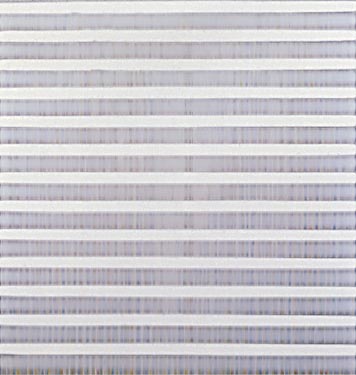
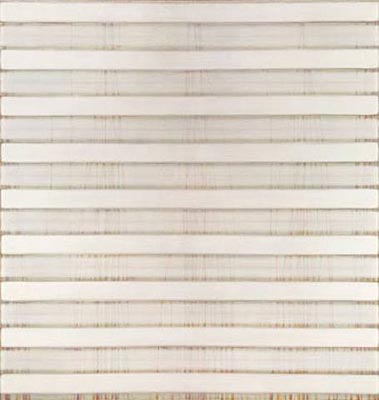

When I heard endless white by Flying Lotus I thought instantly of Agnes Martin. And the way I feel about her. End l e s s white. When I sew embroideries I reference her paintings. "Reinterpreting."
I think you can see how and why my old obsession with tape would lead me to love her work. I appreciate that it is so organized, painstaking, and if you want it to be, referential.
Agnes Martin was a loner. Sometimes I'm afraid to admit that I'm a bit of a loner myself, but then I realize what a good time I'm having and say 'f**k it'.
"My paintings are not about what is seen. They are about what is
known forever in the mind."
Agnes Martin .
Friday, January 1, 2010
Moroccan Wedding Blankets


 I see that artistically I've stayed close to my Arab roots. Says the La viva home website where these Moroccan wedding blankets are sold, "prospective brides and their relatives patiently sewed each sequin by hand. It is believed that the blankets have talismanic power and protect the user from the evil eye." Talismanic powers. Love this phrase. I wonder if Agnes Martin knew these blankets existed?
Tuesday, December 1, 2009
Andrew Wyeth


When I was a freshman in high school my parents switched my sister and I to a new school in a a small town where they owned a lake house. Moving in the middle of the school year is never an easy task, but my sister and I handled it well together. It would prove to be an influential move for us in many ways.
One of the more subtle ways was my discovery of the artist Andrew Wyeth. I had a new teacher named Mr. Bidwell who taught studio art classes with little sessions of art history sprinkled in. One of the paintings we had to learn was Wyeth's Christina's World. This discovery was in some way a studied awakening to taste.
Wyeth's scenes are the equivalent of standing in the middle of a wheat field or prairie at night in winter, not cold but satisfied with only the wind, in awe.
Andrew Wyeth has that so quiet it is loud quality. Agnes Martin has it, Richard Serra has it, Robert Smithson. So many other legends have it. Ann Demeulemeester. Sometimes PJ Harvey. Radiohead, Neutral Milk Hotel, so it goes, screaming into/against the wall. That kind of fierce blank power and its many shades.
Wyeth painted bare moments in time, though enveloped in a silence that is far reaching and full.
SO
MUCH
SPACE.
And that is what I love.
After I wrote this I read an Andrew Wyeth Boston Museum catalog that I bought a while back. I found so many lines and ideas that relate to what I wrote, but even better are the ideas that I was unable to articulate or touch upon in my own thinking. Here are parts of the essay that I loved:
*
Poets, painters, and musicians sometimes choose to live, and strictly operate, within a very special world defined by very special boundaries self-imposed. They do not set out to discover these worlds; they appear to be born within them. As they mature and develop, the shape and character of their environment, accepted or adapted, increasingly appear to strengthen and sustain them technically as well as philosophically. When we read, inspect, or listen to their work we enter into their domain far more than they do into ours. This, it seems to me, is always so.
Wyeth has always been the native son: unhappy traveler away from home, but tireless and uplifted walker on familiar ground, excited by the cleavages of sun and shadow, by implements, by weather, phrenology, a strand of wire, by surface textures - "I love white things. Oh, I love white." And who wouldn't doubt his love of doors and windows, of sudden contrasts between half in, half out?
It was the sweep and freedom of those early watercolors - mostly Maine, it seems to me now - that bowled me over. I was looking into a brand-new world. Far from touching sentiment, the cold kelp-feeling of a down east wind kept blowing on me.
Wyeth's passionate love of fallen snow - not falling snow . . . his fondness for bare textured surfaces, clean tabletops and windowpanes, all contribute to insulate him from the field of physical action.
Looking back on the time when I first saw Andrew Wyeth's early watercolors and portraits and began to urge my friends to buy him, I think today it was a certain freedom and contagious quality of solitude and self-sufficiency I felt in his cool palette that had much earlier reached me in the tonal palette of the symphonies of Sivelius.
Part of the business of art, as Santayana says of music, is to remind us. If a picture doesn't remind me of something in my life that I've forgotten, I am not involved.
How come we should see the wholesale purchase of a powerful silence? For silence - and silence absolute - is one of the strongest elements in Andrew Wyeth's work. Are people hungry for silence?
A lifelong habit of making mental notes of any work of art that has moved me often spills the notes into a journal. Under "W" for Wyeth are these entries:
Journal Entry: In his washes and preliminary sketches, Wyeth always seems to reach for the top of the paper. How many of his pictures are especially rewarding just at the top
Journal Entry: Without a grain of sentiment, and unlike Blake's small figure on the ladder to the moon: "I want, I want!", Wyeth tells us of his infinite own patience. His costumes and his masks at Halloween give him, for a moment, he has told us, anonymity: he just isn't there. If he never gets in the way of his work, his pictures never get in the way of our response.
Journal Entry: Remembering that Wyeth's painter father was his teacher, reminds me that Harvey Cushing, the neurosurgeon, said: "It is a poor teacher whose student does not surpass him."
Journal Entry: To that "powerful silence" one must add "enormous stillness."
Journal Entry: A brooding silence hangs over the Wyeth Landscapes; it is not confined to a room.
Journal Entry: "The world about us would be desolate except for the world within us" ... Wallace Stevens: The Relationship between Poetry and Painting.
All these are the random notes of one who thinks he understands one artists's commitment to his art. Ability, no matter where it stands on the scoreboard of genius, is a great factor. Great also are humility and honesty. Hokusai: "And old man mad about drawing." Andrew Wyeth: a fairly young man still; still mad about drawing.
We love the things we love for what they are.
*
-From an essay by David McCord
p.s. I dedicate this blog entry to Mr. Bidwell & Hammondsport, New York.
Endless White
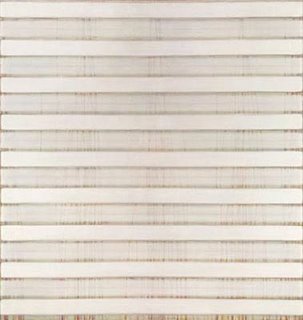
One afternoon I heard endless white by Flying Lotus. I thought instantly of Agnes Martin. And the way I feel about her. End l e s s white. When I sew embroideries I reference her work. "Reinterpreting."
I first learned about her during my peak obsession with tape. All kinds of tape, all kinds of art made of tape. Books, surfaces, quilting and layering. I think you can see why my interest in tape would lead me to love her work. I love that it's so organized, painstaking, and - if you want it to be- referential.
There used to be a wall-sized painting installed near the entrance to the Philip's Collection in Washington D.C. The paint was applied in a layered, tape-like effect. You couldn't tell what it was made of until you were within inches. Just Within inches ... I put a pink heart-shaped balloon in front of the painting, took a polaroid, and got in trouble. You couldn't miss it.
Agnes Martin was a loner. Sometimes I'm afraid to admit that I'm a bit of a loner myself, but then I realize what a good time I am having and say 'f**k it.' I like to think we'd have a lot in common.
"My paintings are not about what is seen. They are about what is
known forever in the mind."
Agnes Martin .
Subscribe to:
Posts (Atom)